Last updated November 18, 2026


Free written scope consultation - allowances, timeline, and change-order rules on paper before a single trade is scheduled
How Long Does Driveway & Pavers Take? Timelines and What to Expect
A contractor who quotes you a 2-day paver driveway is either working on a 400-square-foot path or skipping steps that protect your investment. We’ve watched plenty of West Covina homeowners get burned by a schedule that looked reasonable on paper and then stalled for weeks in the driveway. Real paver installation runs longer than most bids suggest, and the gap between the fast number and the true number is almost always the base work nobody wants to talk about. This guide gives you the realistic schedule, phase by phase, with every variable that changes it, so you can hold a contractor to mile-stones you actually understand.
Quick Answer
A typical paver driveway in West Covina takes 5 to 10 working days from demolition to final seal, with 3 to 5 of those days spent on base preparation alone. Small paths and walkways finish in 2 to 3 days, while large driveways over 1,000 square feet with complex borders, drainage, or slope correction can run 12 to 18 working days. Weather and permit inspections add calendar days, not work days, so plan for 2 to 4 weeks total from start to the day you can park on it.
Styles & brands we work with
- Kitchen remodeling
- Bathroom remodeling
- Home additions & ADU
- Roofing
- Windows & doors
- Driveway & pavers
- Fence
Table of Contents
- The Realistic Paver Driveway Timeline
- Phase-by-Phase Breakdown With Time Ranges
- How West Covina Heat Affects Cutting, Curing, and Sealing
- Permits and Inspections: The Mandatory Hold Points
- Weather Windows: Legitimate Delays vs. Excuses
- Project Milestone Checklist
- Sealing: When It Happens and Why It Waits
- The Final Walkthrough and Cure Time
The Realistic Paver Driveway Timeline
Here’s the honest clock for a standard two-car driveway of about 600 square feet in West Covina: 7 to 9 working days of actual labor, plus a 24 to 48 hour wait before sealing and another 24 hours before you park on it. That’s the number we build schedules around. If a bid lands far below that, ask exactly which steps are being cut.
Where the timeline really stretches is demolition and excavation. A clean tear-out of an old concrete slab can go quickly, but West Covina homes built in the 1950s and 1960s along the older tracts near downtown often have a thicker slab than expected, and haul-off of that material adds a day. Roots from mature ficus and sycamore trees near the driveway edge can turn a half-day excavation into two.
Three things drive the calendar more than square footage alone:
- Total square footage. Under 400 sq ft sits at the fast end. Over 1,000 sq ft pushes into the 12 to 18 day range.
- Base depth required. Flat, well-drained lots need less base; slopes and clay-heavy soil need more, and every added inch costs compaction time.
- Complexity of the field. Straight run, single color, no border: fastest. Herringbone pattern, contrasting border, curved edge restraint: slower.
The biggest driver of a stalled job isn’t labor in our experience; it’s calendar movement from weather and inspections. Those wait days are real, and a good contractor will name them upfront rather than discover them later. If you want the full scope picture before you ever discuss a schedule, our Driveway & Pavers in West Covina page walks through what a complete job includes.
Phase-by-Phase Breakdown With Time Ranges
This is where most written quotes go quiet. Every phase below takes time, and each one is required. Here’s what each step actually costs you in working hours and what it protects.
- Demolition and removal (0.5 to 1.5 days). Tearing out old concrete, asphalt, or existing pavers and breaking up the slab. Haul-off happens the same or next day.
- Haul-off and site prep (0.5 day). Trucking debris out and clearing the subgrade so excavation can start clean.
- Excavation (0.5 to 1.5 days). Digging down to the required depth for the base aggregate. Sloped or clay-heavy lots take longer.
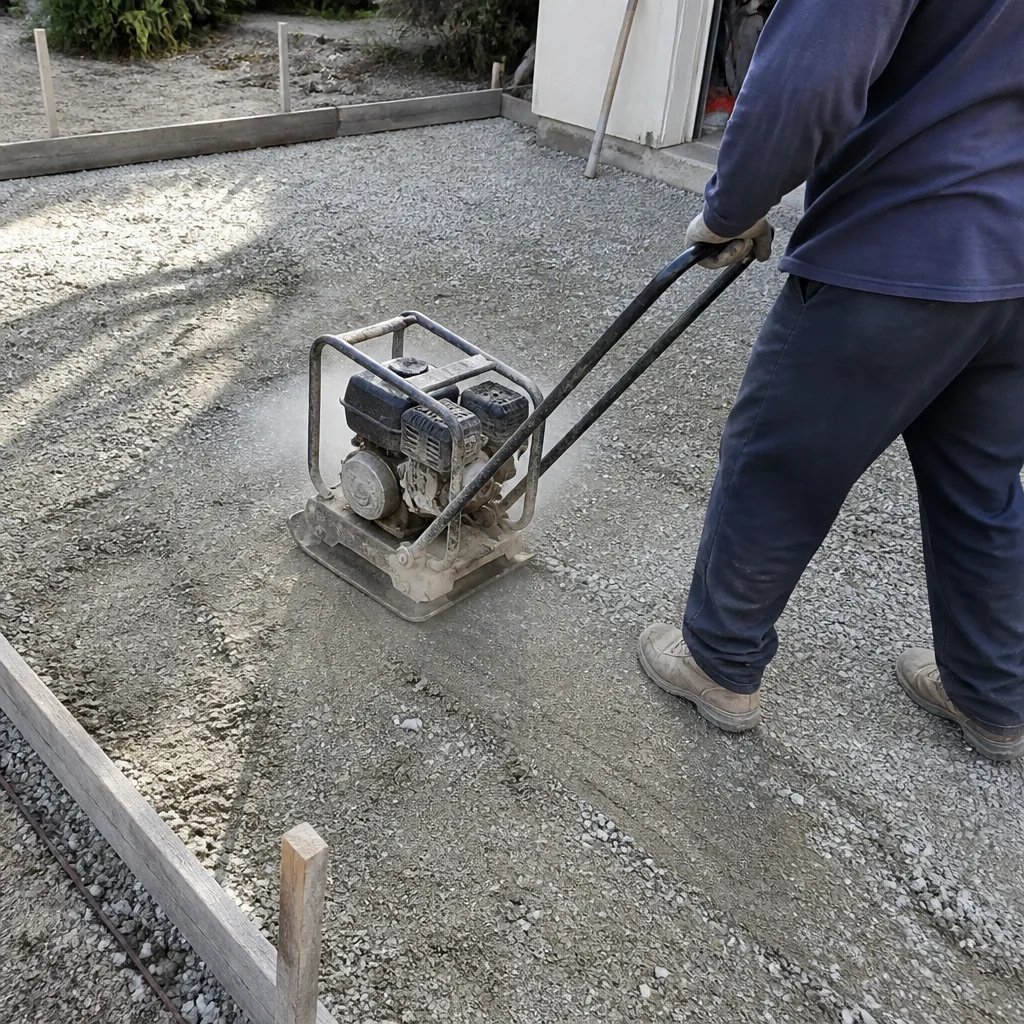
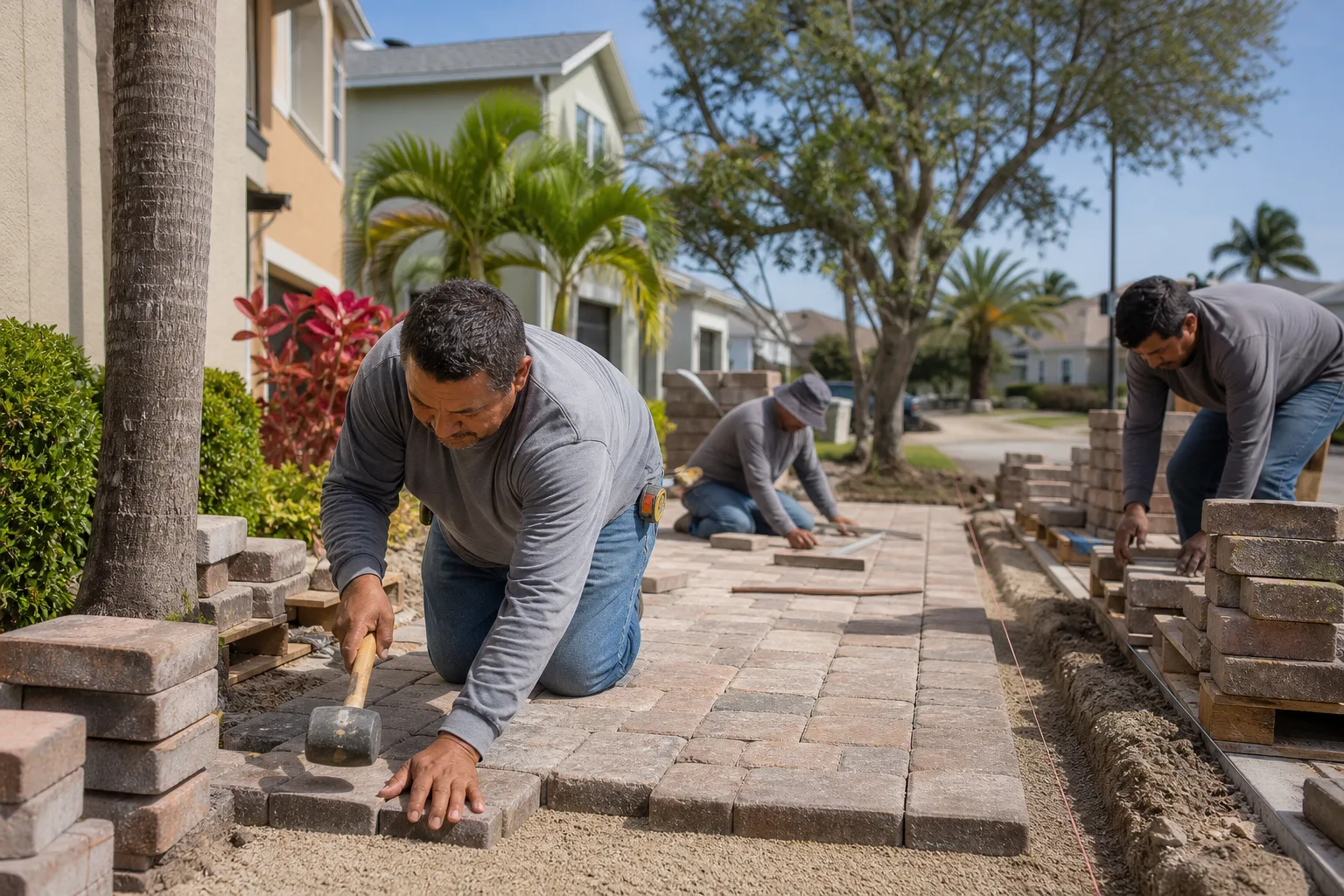
- Base layer and compaction (1 to 2.5 days). Laying crushed aggregate in lifts, then compacting each lift in layers. This is the load-bearing foundation of the whole driveway.
- Edge restraint setting (0.5 day). Concreting or spiking the paver edging that keeps the field from spreading under vehicle weight.
- Sand bed and screeding (0.5 day). Spreading and leveling the setting bed. It has to be perfect before a single paver drops.
- Paver installation (1 to 3 days). Setting, cutting, and laying the field, borders, and patterns. Bigger and more complex fields take longer.
- Joint sand and compaction (0.5 day). Sweeping sand into the joints and compacting the finished surface to lock it all together.
- Sealing (0.5 day, after a cure wait). Applying sealer once the pavers are clean and dry, typically 24 to 48 hours after installation.
Stack that up and you land in the 7 to 12 working-day range for a standard driveway, which matches the Quick Answer above. Confirmation of the base and compaction phases is where you should focus your attention. Skip those and the pavers settle unevenly within a couple of seasons, which is exactly what the 730-Day Done Right Promise from Groundwork Construction Co. of West Covina exists to prevent.
How West Covina Heat Affects Cutting, Curing, and Sealing
Summer in West Covina is a real scheduling variable that contractors from cooler climates routinely underestimate. Daytime temperatures in July and August commonly run into the mid to high 90s, and the jobsite surface temperature on a driveway exposed to full sun can be 20 to 30 degrees hotter than the air. That affects three things directly.
Concrete cutting and edge restraint. Cutting and setting the concrete for edge restraint is done in cooler, early-morning hours in summer. Cutting in peak afternoon heat is possible but slower and demanding on crews.
Curing timelines. The concrete used for edge restraint needs a cure period before it takes full vehicle load, and high heat doesn’t accelerate that in a useful way; it can cause the concrete to cure too fast and crack. A contractor should time the pour for the cooler part of the day and let it cure on a proper schedule, not rush it.
Sealing. This is the big one. Most solvent-based and water-based sealers have ideal application temperatures between about 50 and 85 degrees, and a minimum surface temperature that most crews won’t breach in full-sun summer afternoons. Applying sealer to a hot paver surface causes it to flash and skin unevenly, leaving streaks and patches. In a West Covina summer, sealing is often scheduled for early morning or pushed to a cooler window. A contractor who tells you they’ll seal at 2 p.m. in August with no adjustment is either misinformed or cutting the corner.
Homes nearer the foothills above the 10 freeway catch more heat on south-facing driveways, while properties shaded by mature trees near Shadow Oak Park see cooler surface temps and can be sealed more flexibly. That context matters when the schedule gets built, and it’s exactly the kind of local read a West Covina contractor should bring.
Permits and Inspections: The Mandatory Hold Points
Permits and inspections are not optional friction; they’re hold points that add calendar time and protect you. A driveway replacement that changes the footprint, alters drainage, or touches the public right-of-way typically requires a permit through the city, and inspections happen at specific stages. Here’s why that matters and where a rushed job goes wrong.
- Inspections happen at defined phases. Base preparation and drainage are commonly inspected before the pavers go down. If the contractor skips the inspection and lays pavers anyway, the job may fail on a later inspection or leave you uncovered if something fails.
- Hold time adds days, not hours. An inspection scheduling window is often 24 to 72 hours out, depending on city workload. Those are calendar days the project pauses. Build them in; don’t pretend they don’t exist.
- Skipping inspection voids warranty protections. If a permit was required and the work was done without the required inspection, many warranties won’t cover later failures because the original build was never verified.
- Drainage review is the most common stumbling block. West Covina lots vary a lot in slope, and drainage that sends water toward a neighboring property can trigger correction before the driveway is allowed to proceed.
Ask any contractor directly: “Will you pull the permit and take responsibility for the inspection schedule?” The answer tells you whether the schedule they hand you is real. If a job is large enough that the driveway ties into a fencing or an addition, pull those scopes into the same project plan so the permit timeline isn’t doubled; you can see how that gets coordinated on our Fence Installation in West Covina and Home Additions & ADU in West Covina pages.
Weather Windows: Legitimate Delays vs. Excuses
Weather genuinely moves paver schedules, but not all weather claims are equal. Here’s how to tell a real delay from a stall.
Legitimate delay triggers:
- Rain within 24 to 48 hours of sealing. Sealer needs dry pavers to bond; rain ruins the coat.
- Saturated ground during excavation. You can’t compact a base layer over mud. Drying time is required, usually a day or two.
- Extreme heat during sealer application, as covered above.
- Unusually cold surface temperatures in the coolest winter weeks, which can push curing timelines.
Excuse red flags:
- “Materials are back-ordered” with no ordered date or supplier name attached. That’s vague; ask for the order confirmation.
- “Inspection is holding us up” without a scheduled inspection date. Inspections are scheduled; a real hold point has a confirmed slot.
- No work for several consecutive days with no explanation, no message, and no photo updates. That’s schedule drift, not weather.
In West Covina, the rainy season from roughly November through March is the main weather risk window. A late-autumn start can slip if storms turn the base into mud. Summer’s risk is heat and sealing windows rather than rain. A written schedule that respects both seasons is the mark of a contractor who’s built driveways here, not just quoted them.
Project Milestone Checklist
Use this to check progress against the schedule. If you’re two or more of these milestones behind, ask for a written update with dates. Catching drift early is the whole point.
- Day 1: Permit is on site or number is confirmed. Demolition begins.
- Day 2 to 3: Old material is hauled off. Excavation reaches required depth and base aggregate starts.
- Day 3 to 5: Base layer is being compacted in visible passes. Inspection is scheduled if required.
- Day 5 to 6: Edge restraint is set. Sand bed is screeded and level.
- Day 6 to 8: Pavers laid, cut, and pattern established. You can walk out and see the field taking shape.
- Day 8 to 9: Joint sand swept in and compaction finished. Site cleaned.
- Day 9 to 11: Sealer applied and curing. Do not park on the surface until the contractor confirms the cure window.
Each of these is a visible, verifiable moment. You don’t need to know the mechanics of compaction to see whether it’s being done; you need to see the base gets its passes, the edge restraint goes down, and the inspection happens before the field goes on. If you’re coordinating this with a larger project, the same logic applies, and our Groundwork Construction Co. of West Covina home page shows how the full project scopes connect.
Sealing: When It Happens and Why It Waits
Sealing looks like the simplest phase, and it’s the one most likely to be rushed. A good seal needs three conditions: the pavers are clean, the surface is dry, and the temperature fits the sealer’s application range. That’s why sealing usually waits 24 to 48 hours after installation, and sometimes longer in a West Covina summer.
Why this timing is not optional:
- Wet pavers trap moisture. Sealing over damp joints locks water in and causes a hazy, peeling coat.
- Hot surfaces flash. Sealer skinned on a hot surface settles unevenly, and repairing that means stripping it and doing it again.
- Fresh joint sand needs to settle. Sealing too soon before compaction is fully finished leaves soft joints that shift under the car.
The honest answer for “can you park on it right after you seal it” is no. You’ll be told how long to wait, typically 24 hours, and that is not a delay tactic. It’s the seal curing. A contractor who tells you to drive on it the same afternoon is setting you up for a dull or damaged finish. If you’re building the driveway alongside other outdoor work and want the outdoor scope done coherently, look at the full West Covina driveway and paver scope to see how hardscape ties together.
The Final Walkthrough and Cure Time
When the crew says they’re done, the job isn’t quite done. The final walkthrough is where you and the contractor review the field together, check edges, borders, and drainage, and confirm every milestone in the checklist has been hit. We recommend walking the surface at eye level with the sunlight behind you to spot any unevenness in the field, and testing that water drains away from the slab and toward the intended drainage path.
Cure time is the last scheduling factor. The pavement is walkable and drivable once compaction and joint sand are complete, but the sealer needs its full cure before it protects the way it should. The contractor should give you a specific “safe to park” date in writing. If you’re planning the driveway as part of a larger outdoor build, keeping the cure dates in one schedule avoids the classic mistake of parking a car on the surface to get it out of the way of the fence crew. Our fence installation timeline is built to fit that same project clock.
The final walkthrough is also where the written warranty gets discussed. Groundwork Construction Co. of West Covina backs every driveway with the 730-Day Done Right Promise, and the walkthrough is where that becomes concrete: you know what the guarantee covers, what the cure time is, and what the cleanup standard is. No surprises after the crew leaves.
Common Mistakes to Avoid
- Choosing the fastest bid over the realistic one. A 2-day quote for a 600 square foot driveway means the base and compaction phases are being skipped, and that’s where the driveway fails.
- Letting the contractor skip inspection to “save time.” If a permit is required, the inspection is a hard step. Skipping it voids the warranty protection you were relying on when something fails.
- Sealing on a hot West Covina afternoon. Sealer applied over an 85+ degree surface streaks and peels. Insist on a cooler application window.
- Paying for a layout that ignores local drainage. Lots near the San Gabriel Valley foothills slope. Drainage designed into the base prevents standing water and protects the driveway and the foundation.
- Not requesting a written schedule with named milestones. Without dates in writing, you have no leverage when the crew disappears for four days.
- Parking on the new surface too soon. The sealer needs its full cure. Wait for the date in writing, not the spouse’s guess.
- Not verifying the base depth question. If a contractor can’t tell you how much base aggregate they’re putting down and how many compaction passes, they haven’t planned the job.
See the difference
 Before
 After
 Before
 After
 Before
 After
When to Call a Professional
Some driveway problems are quick fixes and some are signs that the whole build is compromised. Call a professional if your existing driveway is cracked in a way that runs the full length, if water pools against the garage threshold after rain, if pavers are rocking underfoot, or if you’re planning any change to the footprint or slope. Also call if you’ve been quoted a schedule that sounds too fast, because comparing it to the phase-by-phase timeline above is the best way to see what’s missing. Small patios and walkways can be a reasonable do-it-yourself project, but a full driveway replacement that has to carry vehicle weight, drain properly, and pass inspection is not a weekend job. Groundwork Construction Co. of West Covina offers free estimates in West Covina – call (844) 662-2335.
Frequently Asked Questions
A standard 600 square foot paver driveway in West Covina typically takes 7 to 9 working days of labor, plus a 24 to 48 hour wait before sealing and another 24 hours of cure before you park on it. That’s 2 to 4 weeks on the calendar once weather and inspections are counted. Call (844) 662-2335 for a free estimate built on that realistic schedule, not a best-case number.
No, not for a full driveway. A 2-day quote is only realistic for a small 400 square foot path or walkway with no base correction required. Any driveway large enough to park two cars needs the full demolition, excavation, base compaction, edge restraint, sand bed, and jointing phases, which can’t be compressed into two days without skipping work that protects the investment. If a quote says two days, ask for the phase list.
Yes, mostly at the sealing stage. Summer surface temperatures on a sun-exposed driveway can run well above 100 degrees, forcing sealer application into cooler morning windows and sometimes pushing the final coat to a different day. Concrete curing and cutting for edge restraint also get timed to cooler hours. A contractor who plans around the heat keeps the schedule honest; one who ignores it leaves streaks and a weaker finish.
A paver driveway in West Covina typically runs $12 to $22 per square foot installed, depending on base depth, paver selection, pattern complexity, and drainage corrections. For a 600 square foot driveway that’s roughly $7,200 to $13,200 before any site-specific adjustments. Get a written line-item quote rather than a per-square-foot guess. Call (844) 662-2335 for a free on-site estimate with numbers itemized.
It shouldn’t if the bid was written properly. The estimate should be based on the actual excavated condition, with the base depth and compaction requirements spelled out. If a contractor finds thicker concrete or worse subgrade than expected, that should be discussed and approved before any change. Groundwork Construction Co. of West Covina works from upfront pricing with no surprises, so the number you approve is the number you pay. Call (844) 662-2335 for a free estimate.
Yes, when the scope requires it. Driveway replacements that change the footprint, alter drainage, or touch the right-of-way typically need a city permit and at least one inspection. A straight like-for-like replacement in an interior lot may not. We pull what’s required, schedule the inspection, and build the hold time into the project timeline. Call (844) 662-2335 and we’ll tell you upfront whether your project needs one.
The Bottom Line
Paver driveway timelines are misquoted because fast numbers win bids, and the base, inspection, sealing, and cure stages are where the real schedule lives. A realistic project runs 5 to 10 working days of labor for a standard West Covina driveway, with the base work alone taking 3 to 5 days. Weather hold points and inspection windows add calendar days you should plan for. Use the milestone checklist to verify progress, ask for a written schedule with phase dates, and refuse a 2-day promise for a full driveway. When you’re ready to price it with a schedule that respects the work, call (844) 662-2335 for a free estimate from Groundwork Construction Co. of West Covina.
Written by the team at Groundwork Construction Co. of West Covina.