
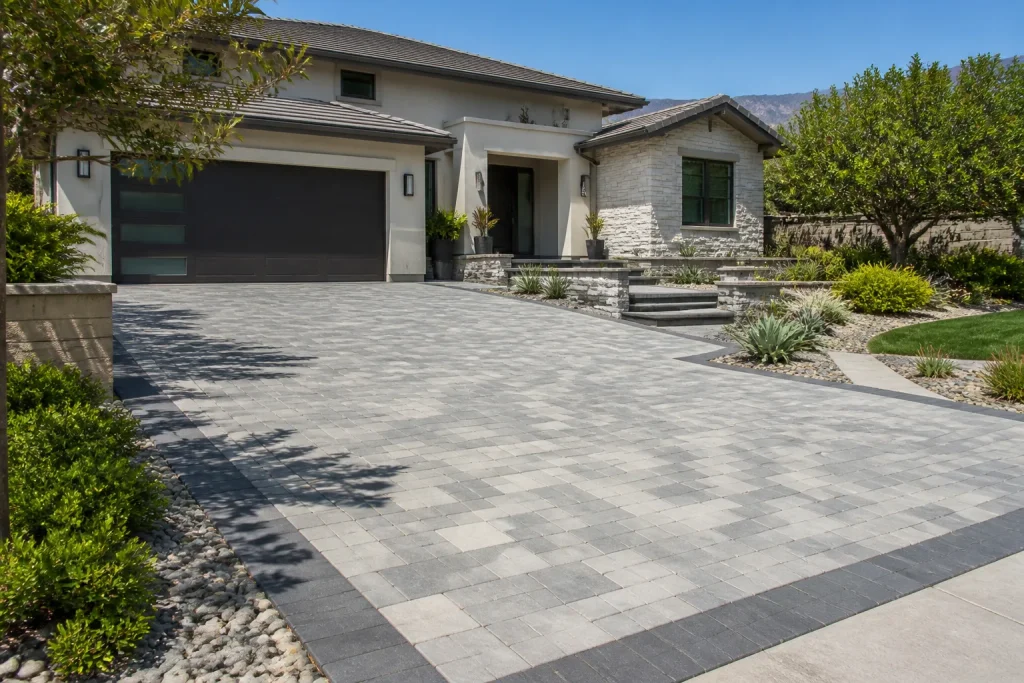
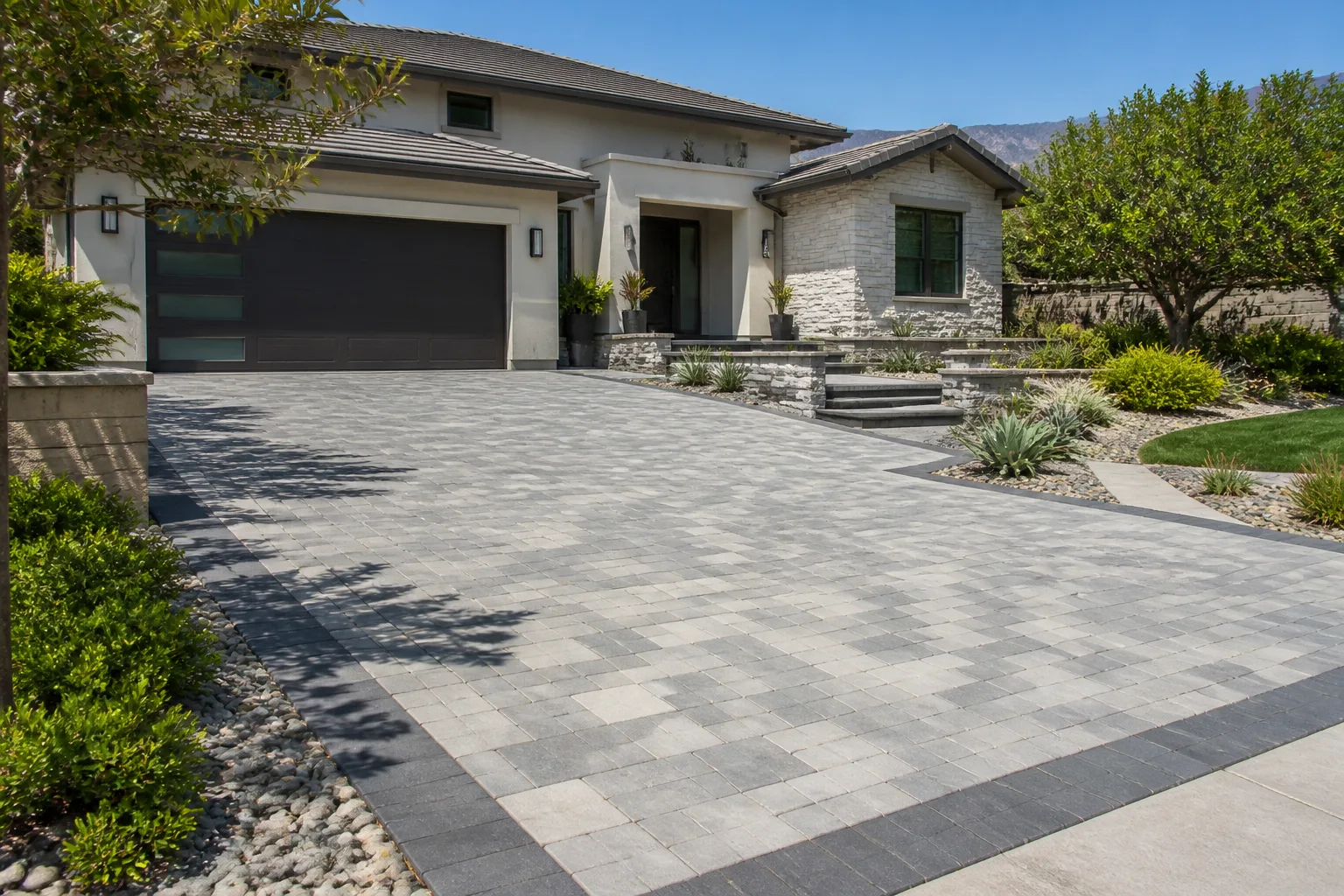
Silestone Driveway & Pavers in West Covina: A Homeowner’s Guide
Silestone’s quartz composite pavers carry a Mohs hardness rating of 7, so they resist abrasion better than most natural stone you can set in a driveway. That same hardness is the trap. A chipped or lipped Silestone paver can’t be sanded or dressed back into line the way travertine can, which means most installation mistakes get fixed one way: pull the paver and reset the base. If you’re weighing Silestone against concrete or natural stone in West Covina, this guide covers where the material earns its premium and where it doesn’t.
If you’d rather not gamble a five-figure driveway on a base-prep decision, call (844) 662-2335 and we’ll walk your project and price it in writing.
What makes Silestone pavers different from concrete and travertine?
Silestone is engineered quartz: roughly 90% crushed quartz bound with polyester resin under pressure. It was built for countertops, and the paver line keeps the same non-porous, sealed surface. Three things follow from that chemistry, and each one matters more in a driveway than a kitchen.
- Water doesn’t get in. Travertine and standard concrete both absorb moisture. Silestone doesn’t, so freeze-thaw and the occasional West Covina winter storm won’t spall the surface.
- Stains stay on top. Oil drips, transmission fluid, and the fallout from a dropped BBQ briquette wipe off instead of soaking in. Efflorescence, the chalky bloom that haunts concrete driveways, doesn’t happen on a non-porous paver.
- Color runs through the slab. A chip on concrete reveals grey aggregate. A chip on Silestone shows the same tone as the face, which is why the material photographs well on a listing.
The catch is that “engineered” cuts both ways. Silestone won’t patina the way natural stone does, so a scratched paver stays scratched. There’s no refinishing stage that hides wear over a decade. What you install is roughly what you’ll have in year ten.
How does Silestone handle West Covina’s heat and UV?
This is where most national paver content falls apart, because it’s written for a generic climate. West Covina sits in the San Gabriel Valley, where summer afternoons routinely push triple digits and the sun hits a west-facing driveway from early afternoon until dusk. That combination is brutal on two materials in particular and kind to Silestone on one count.
The color stability story is strong. Silestone’s pigment is locked in the resin matrix, so it holds tone through years of UV exposure far better than a sealed concrete surface, which chalks and fades, or a stained concrete job, which can go blotchy under intense valley sun. Homeowners on the south and west slopes above Galster Park and along the Azusa Avenue corridor get real, visible value from that.
The heat story is different. Quartz is dense and non-porous, so it absorbs and holds surface heat longer than a lighter-colored, more porous travertine. On a July afternoon a darker Silestone driveway will run noticeably hotter underfoot than a light travertine or a pale concrete pour. Two practical fixes: choose a lighter colorway, and don’t plan to walk it barefoot to the mailbox at 4 p.m. in August.
What base and substrate does Silestone require, and why does skipping it void the warranty?
This is the section to read twice. Silestone specifies a compacted, well-drained, correctly graded base beneath the pavers, and the manufacturer warranty depends on it. Standard paver installs in this region often get by on less base and looser tolerances because concrete and natural stone forgive slop. Silestone doesn’t.
Here’s what a correct install requires, in plain terms:
- Excavation to the right depth. Typically 8 to 12 inches of soil removed depending on your existing grade and the loading the driveway takes.
- Compacted aggregate base. Class II base or equivalent, laid in lifts and compacted each pass, not dumped and graded once.
- Proper drainage fall. A minimum slope away from the garage and foundation, or the driveway becomes a pond every rainy season.
- Edge restraint. A rigid edge that keeps pavers from spreading under a car’s weight.
- Polymeric joint sand. For a non-porous paver in a rain-and-sun climate, the joint sand does the water-shedding work the paver won’t.
Skip or shortcut the base and here’s the failure sequence we’ve seen over and over: a paver lips up where the base settles, water pools in that low spot, and because the surface is non-porous, the water runs into the joints and softens the sand. A single wrong paver then has to come out, and the surrounding field usually goes with it. On a Silestone driveway in West Covina, base prep is 40 to 60 percent of the labor cost. That’s not a sales line, it’s the reason this material performs when it’s installed right and fails when it isn’t.
When you’re comparing bids, ask the contractor what base depth they’re cutting to and whether polymeric sand is included. The cheapest bid is almost always the one cutting the base. Our Driveway & Pavers in West Covina page covers how we spec and price this work in detail.
Silestone vs. travertine vs. concrete: where does the premium actually pay back?
Let’s be honest about the money. Silestone pavers run a premium over concrete, and there’s a range of West Covina driveways where that premium doesn’t return proportional value. Comparison time:
- Standard concrete: Lowest cost, but cracks, fades, stains, and needs sealing. In the valley heat, a plain concrete pour starts looking tired in 5 to 8 years.
- Stamped or stained concrete: Mid-range cost. The stain and seal wear in UV, and a West Covina summer accelerates that fade. Re-sealing becomes an every-few-years task.
- Travertine: Premium price. Genuine natural stone, it ages gracefully and holds color, but it absorbs moisture, needs sealing, and can pit and chip. Some West Covina HOAs love it, some have approved it and then seen staining problems.
- Silestone quartz: Top of the price range. Wins on stain resistance, color stability, and near-zero water absorption. Loses on heat retention and on the high cost of correcting an install error.
The honest verdict: Silestone pays off on a driveway you’ll be looking at for 20 years and want to stay showroom-clean with minimal upkeep. It’s a weaker value on a rental unit, a short-hold flip, or a driveway where budget is the binding constraint. We’ll tell you which camp your property falls into, and it’s not always the one that makes us the most money. Caesarstone and Belgard also make paver products worth pricing if you want a comparison point.
What’s the 10-year maintenance reality in Southern California?
Homeowners are sold “maintenance-free.” That word isn’t accurate for any driveway, Silestone included. What you get is a much lower-maintenance driveway. Here’s what to realistically expect over ten years in West Covina:
- Years 1 to 2: Sweep, occasionally rinse, spot-treat oil with a degreaser. All you touch.
- Year 2 to 3: Top up polymeric joint sand where it settles or washes out after rainy seasons. A small cost, but skipping it lets water reach the base.
- Year 5: Expect a professional set of eyes on joint sand, edge restraint, and drainage fall. If an edge has moved, that’s when it’s cheap to fix.
- Year 10: Possibly a low-pressure wash and re-sand. The pavers themselves will look close to new. The joint and edge systems are what age.
Compare that to a stained concrete driveway that wants resealing every few years, and the maintenance math favors Silestone. The material’s weakness is scratch repair: there’s no refinish step, so keep heavy stationary loads off it and don’t drag a cast-iron fire pit across the surface.
How do West Covina HOAs treat engineered quartz pavers?
The short answer: HOAs throughout West Covina generally approve Silestone more readily than natural stone, because the uniform color and dimensional consistency photograph like a planned surface rather than a random natural pattern. But you still need written architectural approval before a single paver goes down, and the compliance path matters.
Three things come up in practices we see in West Covina HOA architectural reviews:
- Color submittal is king. HOA boards approve a specific colorway with a sample in hand. Show them the exact product, not a website photo.
- Color range consistency. Some boards read the natural variation of stone as “inconsistent” and wave it through anyway. Others want the engineered look. Know which yours is.
- Neighbor-matching clauses. Some West Covina tracts require materials to complement adjacent driveways. Engineered quartz is often the easy political call.
We handle the submittal paperwork as part of the project, but get that approval in writing before you sign a contract. And if you’re updating the front of your home at the same time, our Fence Installation in West Covina page covers HOA-friendly fencing that pairs with a new driveway.
When to call a pro (and when not to)
Silestone is not a DIY paver. The base requirement that makes or breaks the job, the tolerances, the edge restraint, and the lost material from a single wrong set all push this toward a professional install. If the driveway is being cut to proper depth, compacted in lifts, and graded for drainage, you need the equipment and the experience to do that. We’re happy to talk you through what a correct install looks like so you can evaluate bids, but we’d steer you away from installing this particular product yourself.
Our technicians have up to 12 years of experience with paver and hardscape installs, and every project is covered by our 730-Day Done Right Promise: if it’s not done right, we make it right.
Related services in West Covina
Driveways rarely travel alone. If your project touches the front of the house, the crew that sets your pavers can line up the rest of the exterior work: Groundwork Construction Co. of West Covina home covers the full service menu, and if you’re thinking bigger, Home Additions & ADU in West Covina explains how driveways, utilities, and grading get scoped on larger builds.
What happens when you call
- 1
A real person answersNo phone trees – you reach a local pro.
- 2
You get an upfront price rangeHonest numbers before anyone is dispatched.
- 3
A background-checked tech heads outLicensed & insured, dispatched right away.
- 4
You approve before work beginsNothing starts until you say go.
The Bottom Line
Silestone quartz pavers earn their premium on a West Covina driveway that will be looked at for two decades: near-zero water absorption, UV stability under a valley sun that fades concrete and stains, and a color that runs through the slab. They lose on heat retention underfoot and on scratch repair, and the entire investment hinges on a base depth and compaction that can’t be short-cut. Price it honestly, choose a lighter colorway for a west-facing pour, get your HOA approval in writing, and hire an installer who can show you the base work, not just the finished photos.
If you’re in West Covina and weighing a Silestone driveway against concrete or travertine, we’ll walk the site, quote the base prep as a line item, and show you exactly where the money goes. Groundwork Construction Co. of West Covina offers free estimates with no-hassle upfront pricing, the number you see is the number you pay, and $1,000 off projects over $10,000 with 0% financing for 18 months. Call (844) 662-2335 for a free estimate. Calls are answered by a live person around the clock, and every technician who shows up is background-checked and in uniform.
Frequently Asked Questions
Yes, with good base prep. Silestone’s non-porous surface resists staining, moisture, and UV fading better than concrete or travertine in West Covina’s sun, and it holds color for decades. The one trade-off is heat retention: a darker Silestone color runs hotter underfoot in summer, so a lighter colorway is the smarter pick for a west-facing driveway. Call (844) 662-2335 for a free estimate on your specific driveway.
Plan on a premium above concrete, with base preparation accounting for roughly 40 to 60 percent of the labor. Exact pricing depends on square footage, base depth, drainage corrections, and colorway. We quote base prep as a separate line item so you can see what you’re paying for. Call (844) 662-2335 for a written, line-item estimate at no cost.
Yes. Silestone specifies a compacted, properly drained aggregate base laid in lifts, with rigid edge restraint and polymeric joint sand. A shortcut base voids the manufacturer warranty and causes lipping and joint failure, which is expensive to correct because the pavers can’t be resurfaced. Our written quotes spell out base depth so you can compare bids apples to apples.
Usually more readily than natural stone, since the uniform color and consistent dimensions fit planned architectural guidelines. You still need written board approval of the exact colorway before installation. We prepare the submittal as part of the project, but get that approval signed before work begins. Call (844) 662-2335 to start your estimate and get the submittal rolling.
Written by the team at Groundwork Construction Co. of West Covina.
Need Construction Help?
Call Groundwork Construction Co. of West Covina - licensed & insured, here with fast after-hours help in West Covina.
(844) 662-2335